On being Gosei
Or, why Canada doesn't have a Japantown
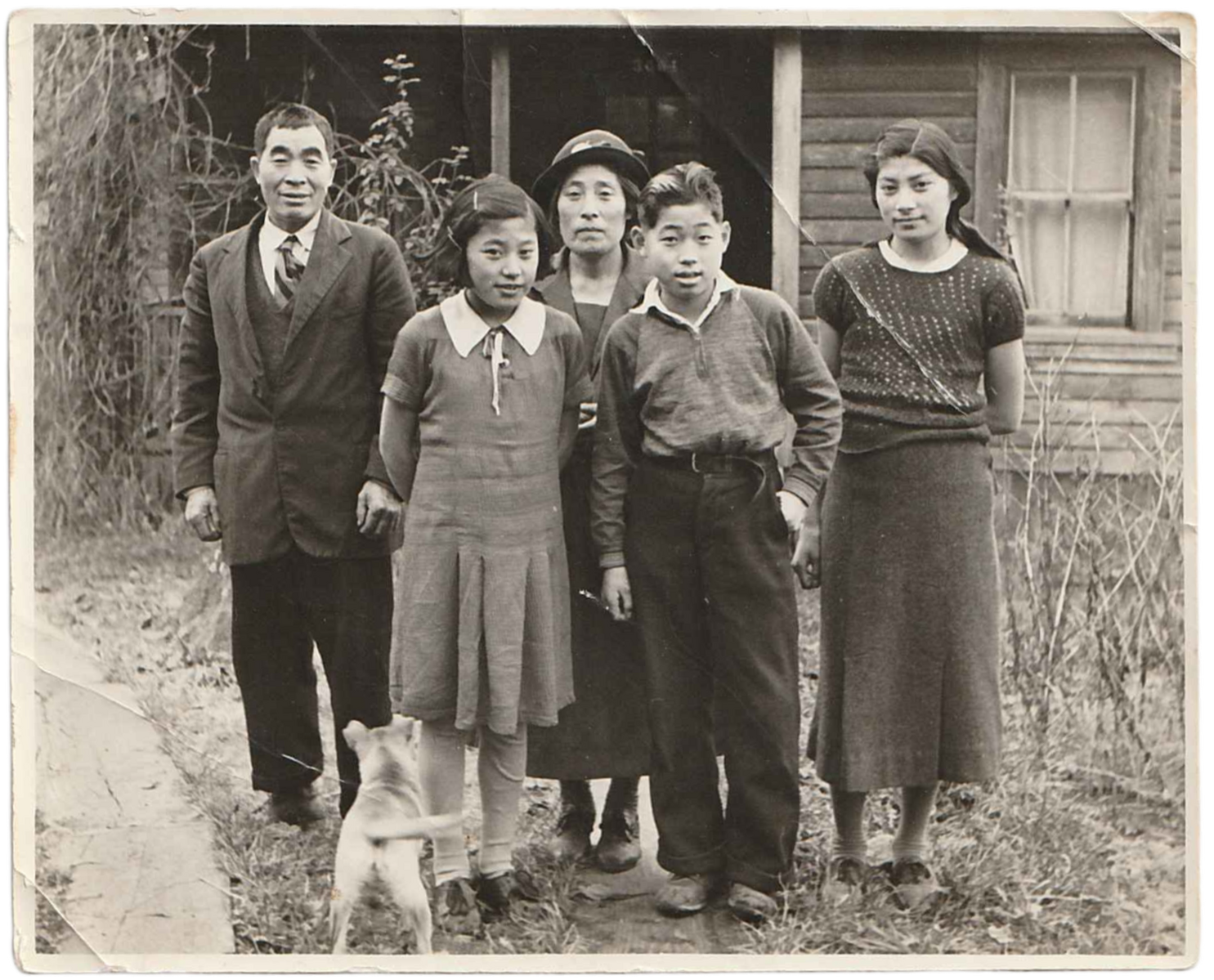
The Takiguchi family. From left to right: Genzaburo, Fusae, Hisa, Takashi (Jack), Sumie.
It was eight years after the death of my grandmother – the last person in the family to speak Japanese – that I decided I was tired of not knowing the people buried on the family cemetery plot.
Asking my mother or grandfather never got far. My grandma was a tight-lipped woman, private in all aspects of life but especially her past. Her Japanese father had died before my mother was born, and what was left of the family didn’t speak enough English to tell their story, refused to, or both.
When I came along in the early 2000s, almost everyone was gone. Photos and documents were squirrelled away in the basement or simply lost to time, and I was a girl who grew up knowing I was Japanese, with a Japanese name and no answer to why.
I’m Gosei, or fifth-generation Japanese. Most Gosei are mixed, with English names (or, like me, an English and Japanese one) and limited knowledge of their language. Gosei and Yonsei (fourth-generation Japanese immigrants) are descendants of people who came to Canada – likely British Columbia – over a century ago, looking for adventure, or jobs, or a society that suited them better than Japan’s. A hundred years isn’t that long ago, yet to so many Yonsei and Gosei, it may as well be ancient history. Trauma from internment camps, being split from their families, mistreatment by the government and having all of their property and possessions seized and sold to the white population of B.C. has led much of the first generations of immigrants to die in silence.
But there has to be more than that. It wasn’t just the stories that disappeared, but the language. The traditions, the food – the things that make a culture. These things survive outside oral history – and yet, for so many families, they didn’t. As more personal records like birth and death certificates become public, there’s a startling lack of Japanese names once you go far enough back – and when they do begin to appear in the mid-1900s, many of them have Anglicised names; Roys, Jacks and Kays run rampant where, in the documents from the early 1900s that do exist, there were Ryos, Takashis and Kyokos. And then, the elephant in the room – why the hell am I here, in Toronto’s outskirts, when I know my family lived in B.C.? Was my family just an especially cagey bunch for me not to know any of this?
When I went to Sandown Market, a Japanese mom-and-pop grocery in Etobicoke, I was coincidentally visiting at the same time a Yonsei woman was. This woman, as she said in her own words, looked Japanese, ate Japanese food and had gone to Japanese language school as a child, but as an adult, didn’t know any Japanese. She didn’t know much about her family’s history except they once lived in B.C. and were forced into an internment camp during World War II. I (foolishly) didn’t ask her name nor her contact info, but as she left, I realized for the first time that maybe, just maybe, this wasn’t a ‘me’ issue.
“They were a difficult people to get on with, to cooperate with. They worked by themselves and for the people of the same race."
Major-General George Pearkes
Most people in Canada know about what happened in British Columbia in 1942, at least in passing. Pearl Harbor. Civilian panic. Internment of the Japanese Canadians.
That’s about where the knowledge ends; for me, it was, at least. We’d never touched on it further in school; it was never brought up in the news, and most individuals who were interned are elderly or have passed away. It wasn’t until I found the photos of my family from so long ago that I began to ponder it seriously. What had really happened in B.C. eighty-odd years ago?
Apparently, asking that question was the easy part. Going through old government documents and personal records was the tricky bit – specifically because there were so many.
It turns out that internment wasn’t the beginning of an intentional movement against Japanese Canadians but its apex. The displacement of thousands of hardworking, law-abiding Canadians wasn’t a fear-driven, spur-of-the-moment decision by authorities. It was an opportunistic, intentional segregation of a minority group with the end goal of deportation.
Anti-Asian sentiment was high before the war. Seen as part of the ‘Yellow Peril,’ Japanese people in Canada had countless restrictions placed on their lives, if not legal, then societal. British Columbia was hellbent on keeping itself white, and that meant limiting fishing licenses, property acquisition and careers beyond hard labour. Nisei children were often kept from their classmates. Provincial and municipal governments passed legislation to discourage Japanese Canadians from entering the workforce, unionizing – or immigrating at all. The individuals that stayed in B.C. were, as 79-year-old Sansei Chuck Tasaka put it, all but segregated into Japantown (present-day Powell Street), further pushing them out of white society – the same society that claimed Japanese people were selfish and prone to isolation.
It still wasn’t enough for the white population of B.C. because when Pearl Harbor happened, politicians jumped at the opportunity to use the War Measures Act and deny the Japanese Canadians all the rights they could. They were fingerprinted, carded, and forced to show their identification if they dared appear in public.
And only then, after decades of systematic exclusion from society, did internment begin.
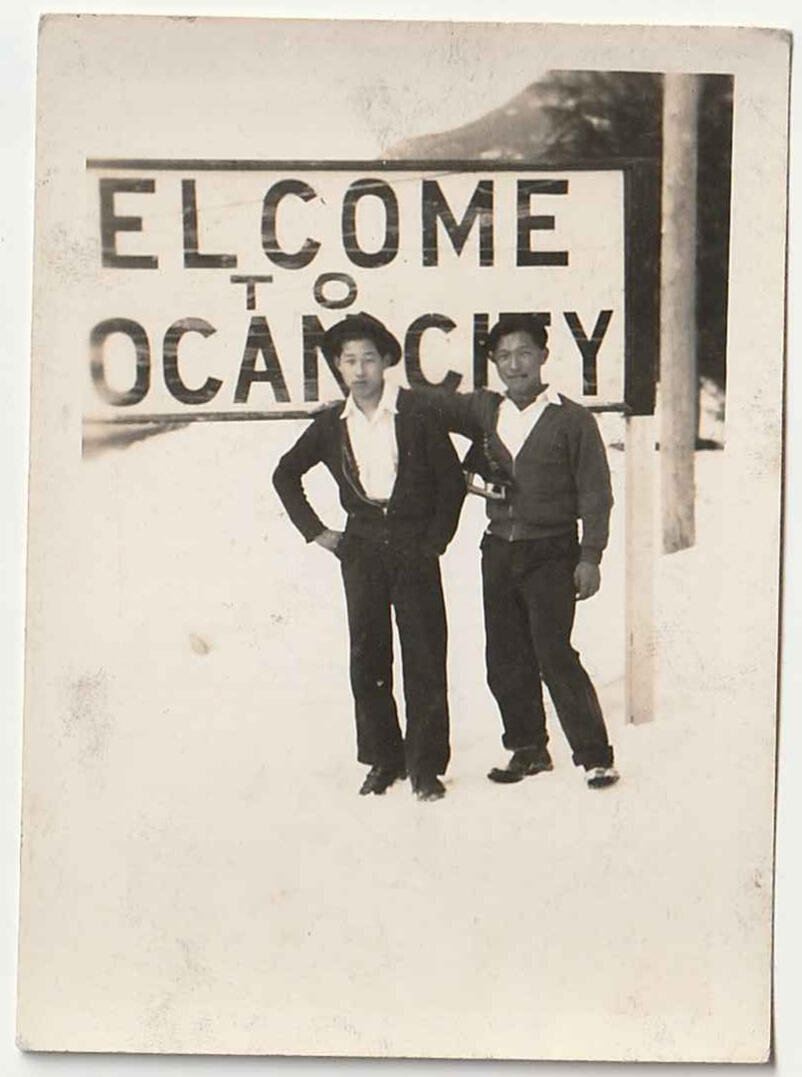
Jack Takiguchi (left) and an unknown boy posing in front of the 'Welcome to Slocan City' sign.
That didn’t satisfy the government either. Property belonging to interned individuals was sold by the government, ensuring that there was no home to return to. Classified documents and letters between politicians are littered with intent to deport all Japanese, regardless of Canadian citizenship. The War Measures Act, meant to be used in times of great need or emergency, was instead used as an excuse to begin the ethnic cleansing of a population, the majority of which were born in Canada or official citizens. A 1944 document titled Steps to Take With Regard to Handling of the Japanese Problem puts it perfectly:
There is no way at present of depriving a British born person of his status. Other measures will have to be examined to provide for depriving all Japanese of British status before their deportation.
There was no intention for resettlement on the coast after the war. Although government officials insisted that those who signed repatriation documents – documents that would see them sent to Japan and stripped of their Canadian citizenship – did so of their own free will, much of the Japanese Canadian population was ill-informed about the affair. Signing for repatriation, they were told, would mean permission to remain in British Columbia for an unspecified amount of time, with funds to sustain them until their travel to Japan. This opposed their other option, which was forced relocation East of the Rockies, with a fraction of the financial relief given, little aid in finding jobs or living arrangements, and the potential to be considered loyal Canadians.
Just potential. Because, as the government officials, newspapers and authority figures repeated over and over again, the Japanese race was unassimilable.
“History will record that, in the light of the desperate situation that existed in this country in 1942, the policy of relocation of the people of the Japanese race was carried out in a humane way.”
Humphrey Mitchell, Minister of Labour
When my Japanese family was told to leave their home and farm in 1942, they, like so many others, were under the impression that they would eventually be able to return. The government itself put out a statement directed towards the Japanese Canadians, insisting that their property was not being confiscated and would be protected from “[the disposal] of their assets at a sacrifice or in an unfavourable market.” So, before being shipped off to a completely unfamiliar town hundreds of kilometres away, they packed important belongings into boxes, noted down what they had, and locked the door behind them. They didn’t have much, according to those lists jotted down; a school bag with books. Four framed photos. A collection of farm tools. A new gramophone and a few dozen records. A few acres of newly-fertilized berries. A single baseball glove.
Within the first year, most of it was gone. Whether the property was ransacked and robbed by white neighbours or items were pocketed by government officials, I’ll probably never know, but by the time the war was over, almost anything of value was missing. The government, under the excuse that they were acting in my family’s best interests (and in reality trying to encourage them to leave), sold the farmland, their remaining belongings and the home they had built from scratch for about a tenth of their worth. They then proceeded to pass any legal fees associated with selling to my family – the same family that had never agreed to sell at all.
I can’t imagine the frustration, the anguish, the exhaustion that must have met my family. They were told to leave the place they had been forcibly uprooted to, only to learn their home and everything in it was gone.
I don’t have to imagine, though. Hisa – the family’s matriarch since her husband’s death in 1935 – and her eldest daughter, Sumie, penned letters to the government demanding recompensation. I don’t know how all five of them – Hisa and her four children – got to Toronto, but they were there to appear in court and fight for their land, their belongings, and the life they’d had on the West Coast. Within the year that internment ended, Hisa Takiguchi endured the government’s insistence that they had acted in her best interest, that it was her fault for not better protecting her home (which was 600 kilometres from the place she was interned), that her farm was too derelict to revive or rent out – that her home’s intrinsic value was nil. Hisa and her children were treated as if they were lucky to get any payout whatsoever.
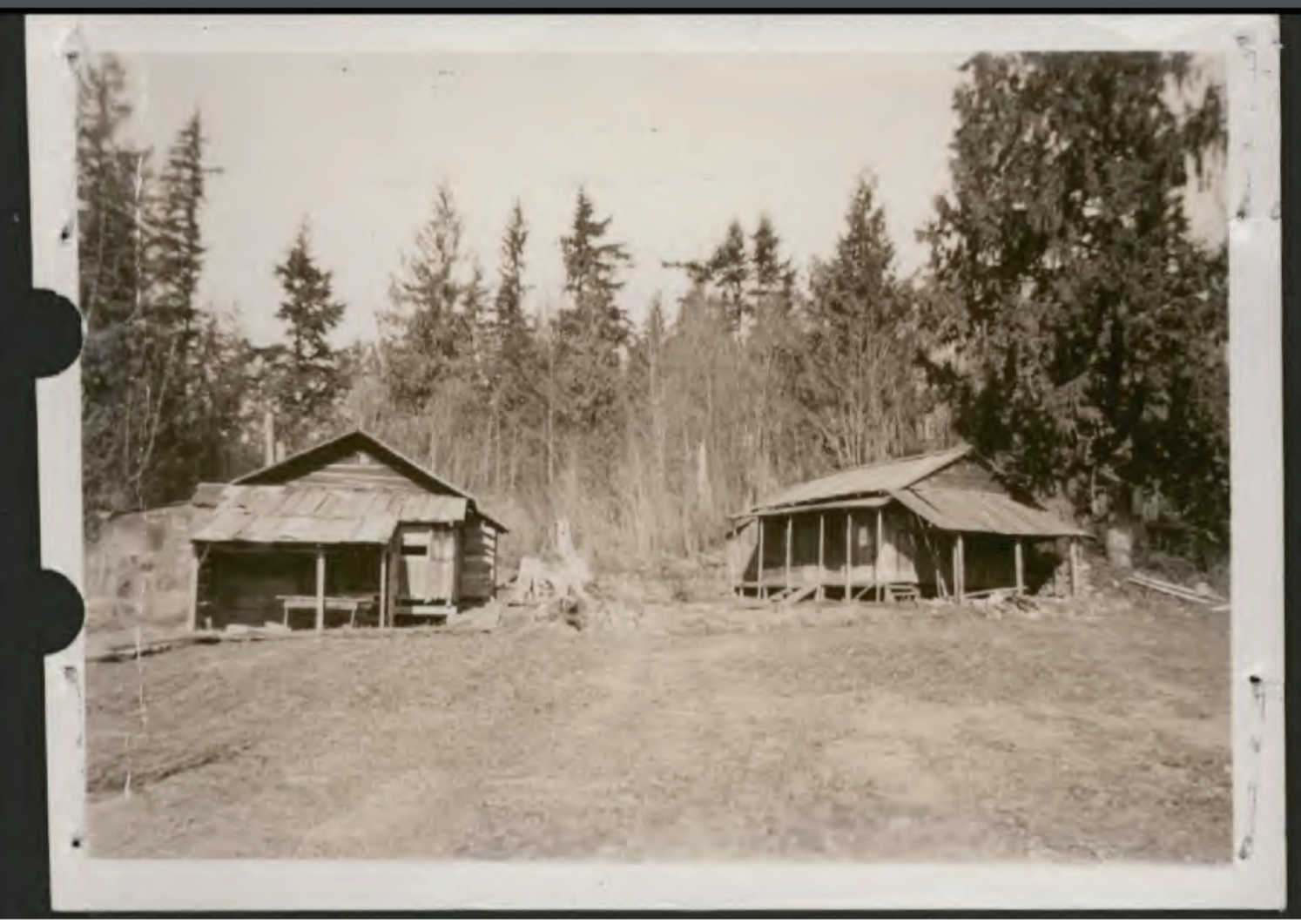
The property whose 'intrinsic value' was deemed 'nil' by the Canadian government.
When I look at the plastic rice bowls in my cupboard, or the lack of Japanese heirlooms in my house, I can’t help but wonder what “disappeared” in those years of internment. How many white folk in the area during the war broke into the “abandoned” house and found an exotic decoration in a Hina doll or free tableware in the house’s single porcelain bottle. How many pieces of my family were stripped away and sold for pennies or set to collect dust on the mantle of a family that didn’t even know what they were?
With all the documentation available, I know how hard Hisa fought for her property and money. I know all of the things that were missing from her home by the war’s end. I know all of the terrible things said about the farm and the house, and how it was taken care of, I know how little the people in the courtroom cared about making things right. I know how little they were given in the end. But I don’t know how they kept going.
How do you, after all of that? How did she – a widow, alone, speaking scarcely any English and with four young adult children at her side – not simply lay down and give up? All five of them would keep living, with addresses in Etobicoke and Toronto’s West End. I can’t fathom how. The only thing I know is that the Canadian government succeeded, at least with them; my family never went back to British Columbia. There was nothing left there for them.
“It would greatly assist the work of the commission and also help toward achieving a reduction in the post-war Japanese population of Canada if Japanese persons could be encouraged to give voluntary indication of a desire to go to Japan after the war.”
Draft memorandum, 10/10/1944
For as long as I can remember, I’ve wondered why no one said anything about any of this. How does a whole history simply vanish over the course of a single generation? I couldn’t comprehend it, how I’d ask my mother for any details and met with an ‘I don’t know.’
When I started looking for answers, that’s exactly what I asked everyone I spoke to; why did people like me or my mom, or the Yonsei woman I met at Sandown Market know nothing about an atrocity that happened at most two generations ago? It’s the question I went into every census record with, every Landscapes of Injustice document, every photo pulled out of dusty envelopes in the basement – why?
Speaking to Dr. Darren Aoki, a co-lead of the Nikkei Memory Capture Project (the other being Dr. Carly Adams), he described what happened to the Japanese Canadian population during the Second World War as a crime against humanity and deeply traumatizing. “You can’t just sort of switch it off and then just go back to normality, right?” is his response to my driving question. “[A]s they’re getting on with work, that’s often a way to just sort of forget about what happened. It’s a way to kind of bury some of that. And in that burying, Sansei and later generations often don’t get told that story.” Additionally, he touched on an important point: after such intense trauma, older generations often didn’t push younger ones to maintain their culture. “[W]hen Sansei say ‘well, I don’t see the purpose in learning Japanese, I don’t really… I’ve gotta get on with my life, education, I’m busy, etcetera,’ the Nisei often don’t push it,” Dr. Aoki said. “I think in other communities there’s often a little more effort that way.”
Chuck Tasaka responded similarly, despite his wildly different background – albeit with more Japanese phrases thrown in. “I don’t know if it’s Japanese culture or not, but anything negative, they want to slip it under the rug, and say, ‘hey, we gotta move on. We’ve got a life to live,’” he said. “They said, ‘kodomo no tame ni, for the sake of the children, we’re going to do this, we’re going to survive this internment. We have to raise our family to the best of their ability.’”
Kodomo no tame ni. For the sake of the children. It’s a phrase repeated often in Nikkei circles, especially in Nikkei literature, right alongside shikata ga nai, or it can’t be helped. Although I’d heard variations of shikata ga nai growing up, both in English from my parents and in Japanese diaspora literature, kodomo no tame ni was newer to me. I’d never really heard it until I started looking into my background seriously, and even then, I brushed it off; of course it was for the sake of the children. Like Chuck said when we spoke, people had ten or twelve children back then – it was nothing but kids!
It wasn’t until I sat down with my mother and read her some of the government declarations about the Japanese Canadians, or the things written about our family and their property, that it clicked for the first time. Although I was equal parts thrilled and devastated to find these vile statements, my mother always looked about to cry. “That’s so awful,” she’d say, looking away from the screen before she could get more than a glimpse of whatever was on it. “It feels like, every time you say these things, you’re pulling on threads that connect directly to my heart. It hurts.”
When she first said that, I sat with her in silence for a moment as the weight of it settled in the room. Everything I knew of these people – my ancestors from not-so-long-ago – was second, third, or fourth-hand, but for my mother, their stories were told by people who’d known them personally, intimately. The love that my grandmother had for Sumie was expressed right to my mother; the respect everyone held for Hisa lived in the air she breathed as a child. For my mother, these transgressions weren’t so many levels removed. They were events that happened while she was in utero.
My mom never cried when I told her these things or showed her old photos, and I wonder how much of that is because I was there. No parent wants to cry in front of their child. I have to assume that extended to Hisa, too, to her children and their children. With four kids, no home and a government determined to make her practically disappear, I can’t imagine Hisa had time to cry.
Even without children, I limit how often I look at these old documents and photos, because I don’t have time to cry about them. It’s so, so much easier to just lock them away. Forever.
Kodomo no tame ni. My mom never said the words, but she gave me the answer, and it almost hurts more than knowing nothing.
“The people of the Japanese race are so fundamentally different that they cannot be assimilated as Canadians.”
Senator John Wallace de Beque Farris
Despite the provincial and national governments’ insistence that the Japanese Canadians were a lesser-than, selfish, unassimilable race, they, for lack of better words, became a ‘model minority.’ Striving for normalcy, seeking higher education, well-paying jobs, and property ownership, the already-small Japanese population in Canada either returned to Japan or settled into life across the country. Prime Minister W.L. Mackenzie King had announced that the “best policy for the Japanese Canadians themselves is to distribute their numbers as widely as possible throughout the country,” and with some aid (forcing) from the government, they did just that. Japanese Canadians were instructed to go East of the Rockies, or get on a boat to Japan – a country many of them had never stepped foot in – and start over like nothing happened.
Once again, the Japanese Canadian population was scattered. This time, however, instead of in camps across B.C., it was across an entire country. Some stayed in the areas they’d been interned in; Chuck Tasaka’s hometown, Greenwood, actually fought to let their Japanese residents stay. Greg Nesteroff, a history buff from Slocan, the area my family was interned in, said that his parents grew up with Japanese Canadians. “By the time I was in high school, [the Japanese Canadians] had essentially moved away,” he said when I asked if he knew anyone Japanese growing up. “I’m thinking it must have been in the 70s that people started to gravitate towards the lower mainland, or wherever they went,” he continued as we spoke about the decline of the Japanese population in the area. “Some of those families did go – it was the kids going to like, university, and then they didn’t come back. Their parents died, and that was that.”
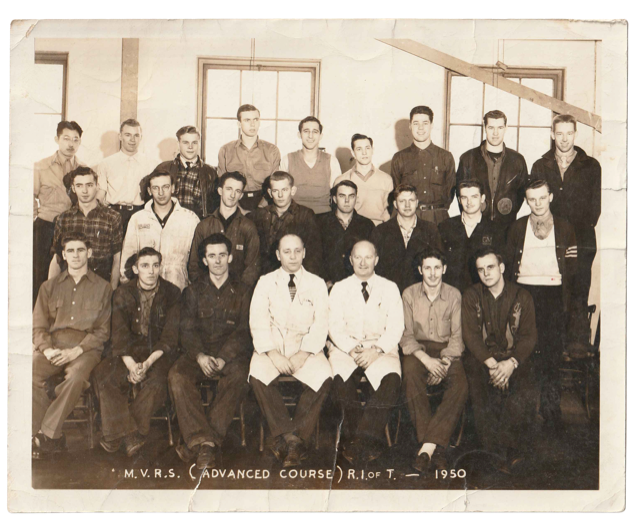
Jack Takiguchi's (far left, upper row) graduation photo, 1950.
‘Wherever they went’ wasn’t back to the coast – at least not for most. Chuck, who is often between Greenwood and Vancouver these days, agreed that the Japanese Canadian population never recovered along the coast. Some cities that had internment camps have a small handful of Nikkei left living there. In Lethbridge, where Dr. Aoki and Dr. Adams' project is based, there is a community – several communities – but it lacks infrastructure and financing compared to similar cultures in the area, like Chinese Canadians. Toronto’s Japanese Canadian Cultural Centre and the Toronto Buddhist Church are longstanding pillars of the Japanese Canadian community, but outside the walls of those buildings, the community is sparse.
Canada’s government and population all but told them to disappear. It’s difficult to fault a scattered, scarred population for doing so.
Even when the redress movement in the 1980s gained momentum, not all Japanese Canadians were on board. Decades after segregation, internment and the ultimatum that saw the end of it all, many of them had settled in new cities with families, careers and houses. As seen in Tomoko Makabe’s The Canadian Sansei, many simply wanted to keep the events of the 1940s in the past. Some Nikkei (mostly second generation) she interviewed expressed concern for the potential backlash redress could cause, insisting that it was “water under the bridge,” or to “forget all about it.” For others Makabe interviewed, the movement’s success was like winning the lottery. Similarly, when I asked him about it, Chuck Tasaka described redress happening in 1988 as “like a miracle.”
I don’t know what my family’s stance on the redress movement was. Like everything else, they never spoke of it. It’s entirely possible that they simply ignored it, uninterested in picking at wounds that had just barely healed, or donated the money. Perhaps Hisa put it towards the sizable cemetery plot in Toronto, or used it for her children’s weddings. It’s another snippet of history lost to time, I suppose, buried under layers of trauma and assimilation. It’s hard to be upset about that, though, when I’ve found so much. After all, with the help of so many people and resources, the names on the gravestones are no longer strangers.
“I am unsatisfied with your actions that I am not surrendering my Title. I consider your amount as part payment from you. Therefore, I will hold the cheque until satisfactory agreement is heard from you.”
Hisa Takiguchi
When I began this piece, I anticipated an unhappy ending, or a bittersweet one at best. The interviews in Tomoko Makabe’s 1998 book found that many Japanese Canadians in Toronto were of the opinion that the Japanese Canadian culture was on a decline, bound to vanish sooner than later. Reading it in 2023, I was dismayed but found myself agreeing. The only Japanese person I knew intimately was second-generation and knew little about the internment camps. The Japanese population in Canada was a measly 0.3%. Like an individual in her book said, it seemed to be a sinking ship.
Writing this piece, meeting people from different corners of the community, and examining my own history, I’ve changed my mind. More projects than ever are focused on preserving the history of Japanese Canadians. Landscapes of Injustice, the Nikkei Memory Capture Project, the Nikkei National Museum. The little archives tucked away in B.C.’s interior, the blogs like Greg Nesteroff’s that detail histories that would otherwise go untold. People like Chuck Tasaka, living in Greenwood, piecing together people’s histories. The vast diversity documented by people like Dr. Aoki. The 2010s and 2020s have seen an attempt to memorialize the stories that have otherwise gone unheard in ways I couldn’t have imagined. The excitement in other Japanese Canadians’ eyes when I tell them I’m Gosei, that I’m trying to piece this all together, is genuine. Without putting a hand on me, it feels like I’ve been hugged. It feels like coming home.
Everyone I spoke to during my quest for answers told me that, despite the lack of physical, tangible community, something was happening. That Yonsei, Gosei and non-Japanese alike were looking for answers, that there was interest, that, despite how many stories have disappeared, there is an attempt to dig them back up. That there is a scattered but committed community to welcome anyone interested, whoever they may be.
When I asked Reiko what she’d tell anyone like me – mixed, Gosei, isolated from my Japanese culture – she replied without hesitation as she bagged a customer’s groceries, “Even if you don’t know, look over the history and learn, but have pride in being Japanese in that way. You’re still Japanese.”
I might not look Japanese, or speak Japanese, and I might not have known any of the family that did. But she’s right. Just like the people in the photo — the people I came from — I’m still Japanese.
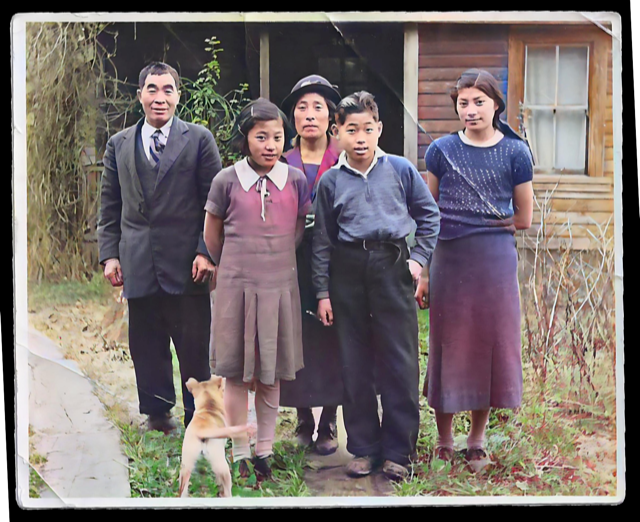
The Takiguchi family, colourised.